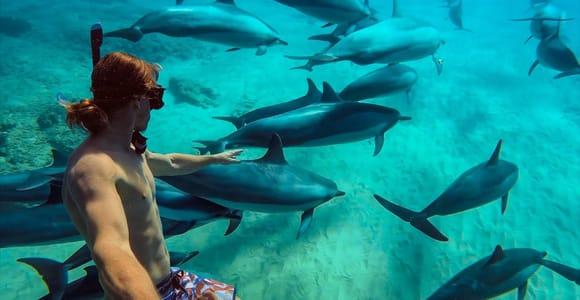
Swimming with dolphins in Zanzibar: read this before you book
Updated September 24, 2026 · 6 min read
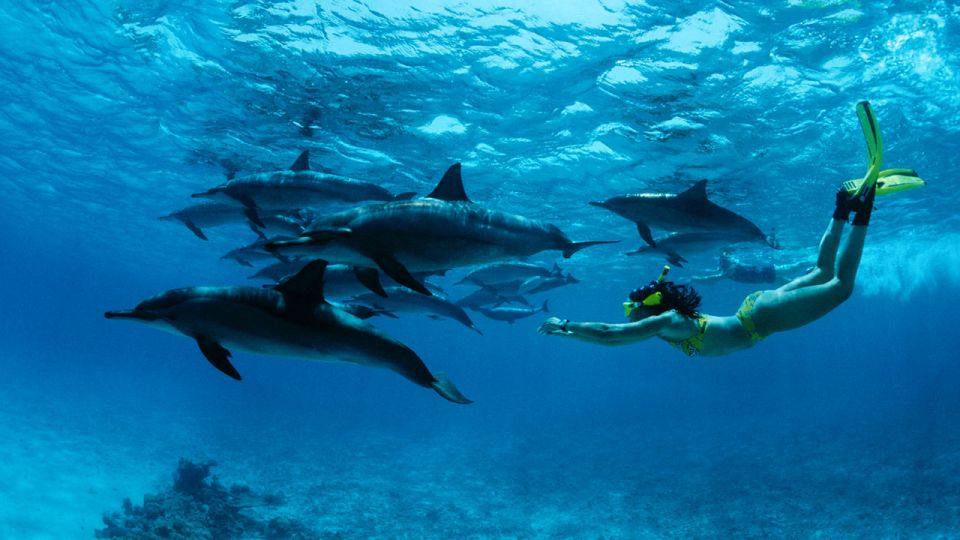
This is the one activity on Zanzibar where the honest answer is not “yes, book it”. It is “it depends entirely on how, and here is what is known”.
Dolphins are the island’s second-biggest water draw after the sandbanks – 90 offers from €14.41 at swim with dolphins. That price is the problem and the clue at the same time.
Two very different places sold under one word
Kizimkazi, in the far south, is where “swimming with dolphins in Zanzibar” originally meant something. The village sits inside the Menai Bay Conservation Area – established in August 1997, 470 km², Zanzibar’s largest marine protected area, originally set up to stop the collapse of local fish stocks. Two dolphin species live there year-round: the Indo-Pacific bottlenose dolphin and the Indian Ocean humpback dolphin. These are resident animals in a defined bay, which is why boats can find them so reliably – and why the pressure on them concentrates.
Mnemba atoll, off the north-east coast, is the other one. Here the dolphins are a bonus on top of what is genuinely the best snorkelling on Unguja, over a reef that is a declared marine conservation area. One thing to know before you picture it: Mnemba island itself is private. Access is limited to guests of the lodge on it, and boats that come too close to the beach are turned away. A trip sold as “Mnemba” is a trip to the reef and the water, which is the good part – but you are not landing on that island.
If you want a snorkelling day with a chance of dolphins, that is Mnemba. If you specifically want dolphins, that is Kizimkazi, and the next section is for you.
What the research from this coast actually found
Most of what circulates online about “ethical dolphin tours in Zanzibar” comes from tour operators’ own blogs. Some of it is sensible; none of it is a regulation, and you should not treat a listed code of conduct as something anybody is obliged to follow.
What does exist is peer-reviewed work from this exact stretch of water. Stensland and Berggren published a study of Indo-Pacific bottlenose dolphins off southern Zanzibar in Marine Ecology Progress Series in 2007. They found that nursing females changed their behaviour when tour boats were present – swimming and travelling more, and so spending less time on the resting and nursing that calves depend on. The authors raised the possibility that sustained boat pressure could push nursing mothers out of the areas with the heaviest traffic altogether.
That is the finding, and it is nearly twenty years old, from a bay that has had two more decades of boat traffic since. It does not say the activity is impossible to do decently. It says that the number of boats, and how they behave around a pod, is the variable that matters – not whether the brochure used the word “ethical”.
What the ratings say, which is more than you would expect
Reviews are a blunt instrument, but with these volumes the pattern is hard to dismiss.
The four highest-volume dolphin trips in the current stock:
- €48.31, Mnemba day tour from the north-east, 2,168 reviews at 4.3 stars
- €48.31, from Kendwa to Mnemba, 1,372 reviews at 4.7
- €17.52, Mnemba dolphin swim and snorkel, 895 reviews at 4.2
- €16.54, Mnemba dolphin and snorkelling, 512 reviews at 4.1
Weighted across all the dolphin and turtle-swim offers with a meaningful number of reviews, the category averages about 4.4 – against 4.7 for the mainland safaris and 4.5 for the spice farms. It is not the island’s worst category. The two cheap trips sit at 4.2 and 4.1, and the best score on the list belongs to a trip at nearly three times the price. Price alone does not buy it, though: the most booked trip in the category costs exactly the same and comes in at 4.3.
The cheap end of dolphin trips is where you find crowded boats, short water time and the chasing that produces both a bad experience and a bad outcome for the animals. Those two things are the same problem seen from two directions, and the star rating is picking it up.
The version that is defensible
If you want to do this, these are the things to establish before you pay, because none of them can be fixed on the day:
Go at first light. The boats concentrate mid-morning. An early departure means fewer hulls on the same pod and calmer water, and it is the single biggest difference between a good trip and a bad one.
Ask how many people are on the boat, and how many boats the operator runs. A small boat that does not need to compete for position behaves differently from one that does. This is a question with a number for an answer; if you cannot get one, that is also an answer.
Ask what happens if the dolphins are not found, or not approachable. A good operator will say the trip goes on and you snorkel. An operator who guarantees you will swim with dolphins is telling you how they intend to get you into the water.
Do not touch, do not feed, do not swim at them. Let animals approach or not. This is standard practice rather than enforced law here, which is precisely why it has to come from you and your guide rather than from a sign.
Consider not getting in. Watching from a boat that is holding position is a genuinely good hour, and it removes the part of the interaction the research found to be disruptive. Nobody will suggest this to you at the jetty.
The alternatives, if this has put you off
That is a legitimate outcome, and the island has better-rated options at similar money.
Snorkelling without the dolphin framing. Same reefs, same boats, no pressure to chase anything – 88 offers from €10 at snorkelling.
The sandbanks. Prison Island with its Aldabra giant tortoises and the Nakupenda sandbank are the island’s most booked water day, and no wild animal is being pursued – 137 offers from €10 at island tours.
Jozani. Wild animals, in a national park, that you watch from a footpath – Jozani Forest and the red colobus.
One last thing about the turtle swims that appear alongside the dolphin listings, at Salaam cave near Kizimkazi and at the Nungwi aquarium: those are enclosures with fed animals, not wild encounters. Some people are entirely comfortable with that and some are not, but it should be a decision rather than a surprise when the boat pulls up. How it all fits into an island week is in what to see in Zanzibar.